Short answer
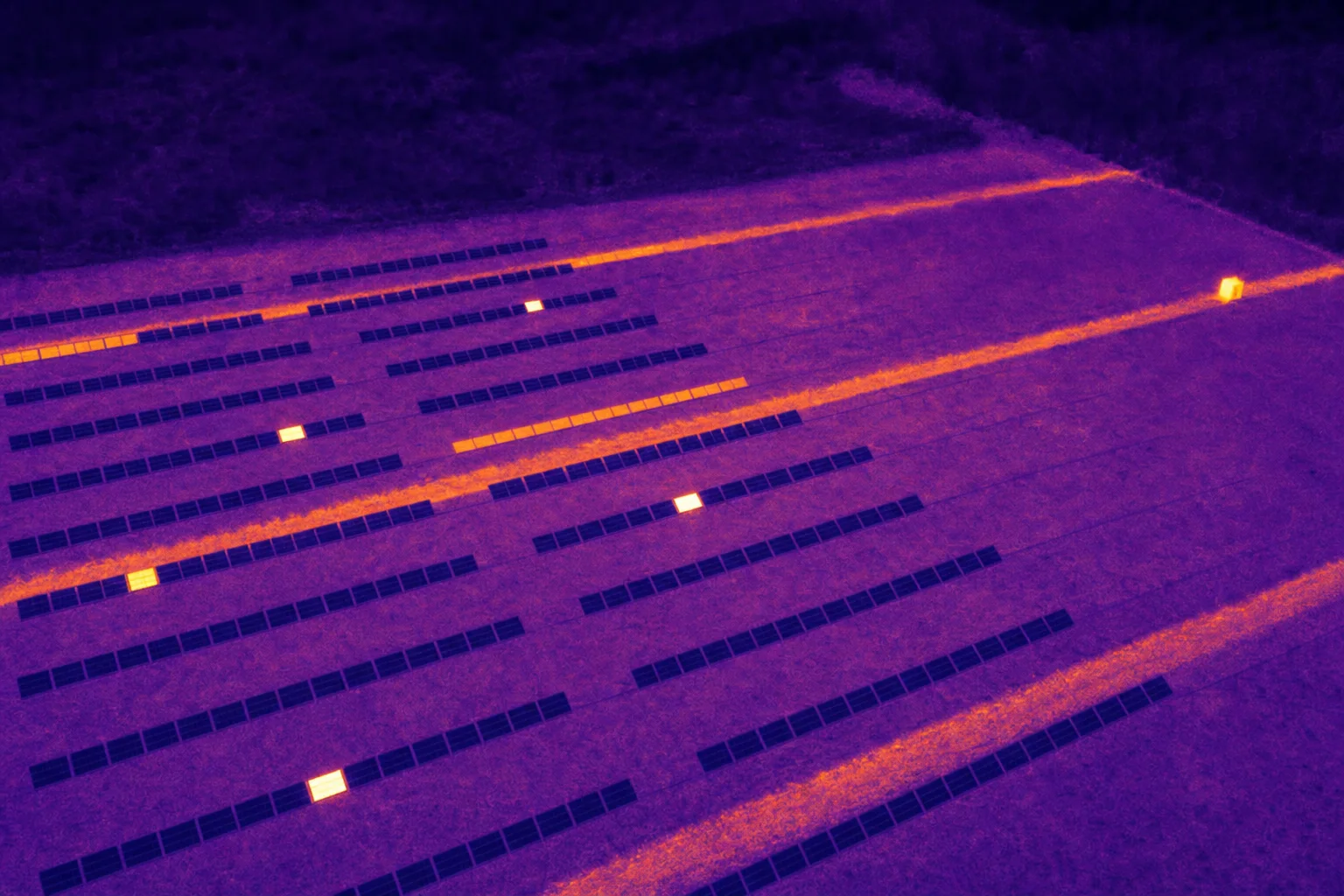
A drone thermal inspection flies an infrared camera over a working solar plant and finds modules that run hotter than their neighbours. The heat pattern points to the cause: a single hot cell suggests a crack or hot-spot, a hot third of a module points to an active bypass diode, and a whole warm module or row suggests a disconnected module or string. IEC TS 62446-3 sets out how such inspections should be done and classified.
Why inspect solar panels with a thermal drone?
A module that is not converting light into electricity turns more of it into heat. An infrared camera sees that heat directly, so a single flight reveals faults across thousands of modules that would take days to find from the ground. Pairing each thermal image with an RGB image of the same module separates real faults from reflections and dirt.
What conditions does a thermal PV inspection need?
Thermal contrast only appears when the plant is producing. IEC TS 62446-3 specifies minimum conditions; in practice the key ones are:
- Irradiance of at least 600 W/m² in the plane of the modules, stable during capture
- Clear sky, without passing clouds that change irradiance mid-flight
- Plant operating under normal load (inverters on, not curtailed)
- Low wind, which otherwise cools modules unevenly
- Viewing angle and image resolution sufficient to resolve individual cells
What anomaly types does a thermal inspection detect?
Each fault leaves a characteristic heat pattern:
| Anomaly | Thermal pattern | Typical cause |
|---|---|---|
| Single hot cell / hot-spot | One cell clearly warmer than the rest | Cracked cell, local shading, manufacturing defect |
| Multiple hot cells | Several scattered warm cells | Micro-cracks, cell degradation |
| Active bypass diode | One third of the module uniformly warm | Faulty cell string or shading in that sub-string |
| Open module | Whole module warmer than neighbours | Disconnected module or failed connector |
| Open string | A full row of modules uniformly warm | String disconnected, blown fuse, breaker off |
| Soiling / bird droppings | Irregular warm patches matching dirt | Dust, droppings, debris |
| Vegetation shading | Warm cells along the lower edge | Grass or shrubs growing into the array |
| Junction box heating | Hot point at the junction box | Poor contact or diode failure |
How does IEC TS 62446-3 classify anomalies?
The specification groups findings into classes of abnormality (CoA). Broadly, CoA 1 is a module without abnormality, CoA 2 is a thermal abnormality that should be investigated and scheduled for action, and CoA 3 is a safety-relevant thermal abnormality that needs prompt action. The class depends on the pattern and on the temperature difference relative to healthy modules under the measured conditions. control.io reports each anomaly with its type, its class and the conditions at capture.
What does a good solar inspection report contain?
A report should let a field crew walk straight to each fault:
- A geo-tagged map of the plant with every anomaly pinned to its module
- For each anomaly: thermal and RGB image, type, class and temperature difference
- Irradiance, ambient temperature and wind at capture time
- A prioritised list, safety-relevant findings first
- A comparison with the previous inspection where one exists
How often should a solar farm be inspected?
Many owners inspect annually, plus at commissioning and before warranty expiry. Plants with known issues, heavy soiling or vegetation growth benefit from more frequent flights. A repeat inspection on the same flight plan shows whether earlier faults were fixed and whether new ones are appearing.
Sources
- IEC TS 62446-3:2017. Photovoltaic (PV) systems – Requirements for testing, documentation and maintenance – Part 3: Photovoltaic modules and plants – Outdoor infrared thermography. Inspection conditions and classes of abnormality.
About the author
control.io Field Engineering Team
Civil engineers, licensed drone pilots and photogrammetry specialists who run control.io's site supervision and inspection flights.